
Here’s a question that’ll stop you in your tracks: Would you let someone walk up to you, take your wallet, empty out all your cash and credit cards, and leave your family with nothing?
Of course not. That’s insane.
But if you’re in sales and you let rejection stop you from making calls, booking appointments, and closing deals, that’s exactly what you’re doing. You’re handing over your commission check to fear.
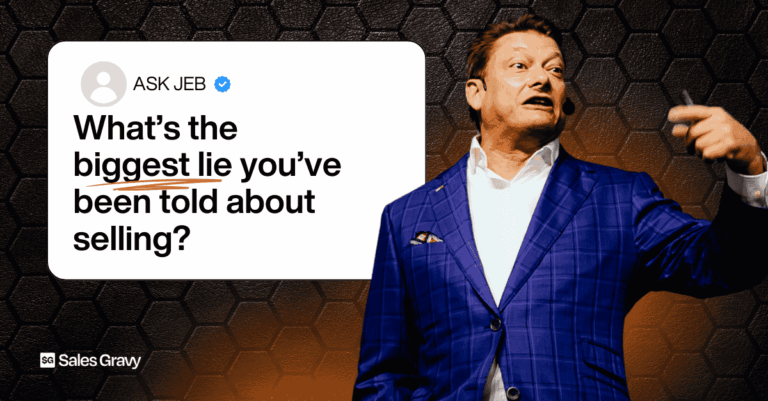
That was the powerful insight from Wendy Ramirez, a leading Mexican sales expert and author of Lo que nadie habla de las ventas: Estrategias para no ser llamarada de petate or What Nobody Talks About in Sales: Strategies to Avoid Being a Flash in the Pan, on a recent episode of Ask Jeb the Sales Gravy Podcast. When you give rejection the power to stop you, you’re literally taking money away from your family. Let that sink in.
The Science of Why Rejection Hurts
Let’s get one thing straight right now: I’m not going to sit here and glorify rejection. Nobody wants to be rejected. Unless you’re a pure sociopath who feels nothing (and there aren’t many of those in sales), rejection is going to hurt you.
It doesn’t matter if you’re highly outcome-driven like me or highly empathetic. Rejection hurts everyone in different degrees, but it hurts. Period.
Here’s what’s actually happening inside your body when you get rejected: Your brain treats rejection like a physical threat. Fight or flight kicks in. It’s a neurophysical response that dumps adrenaline into your bloodstream, makes your heart race, and creates this overwhelming urge to either run away or fight back.
That uncomfortable feeling? That’s not weakness. That’s just science.
The Problem: Sales Is a Rejection-Dense Profession
Here’s the brutal reality about selling: If you don’t face rejection, you’re going to fail.
Sales is what I call a rejection-dense profession. When you hit rejection in sales, you don’t have the option of going backwards. You can go over it, through it, around it, or dig under it. But your job is literally to go out into the world, find rejection, and bring it home.
That’s the job description. That’s what we signed up for.
Think about it like this: A few years back, I got invited to jump out of an airplane with the Golden Knights, the U.S. Army’s elite parachute team. I’m not a skydiver (just like I’m not a Spanish speaker), but what an honor to jump with probably the best parachute team worldwide.
I asked the guy I was tandem jumping with how many times he’d jumped. Ten thousand times, he said. So I asked him, “Do you ever get afraid?”
His answer changed everything for me: “Of course, I get afraid. I’m jumping out of an airplane. Your body is going to get afraid. I’ve just done it so many times that I know exactly what the process is. I’m able to get myself to jump even though my brain says this is the wrong thing to do.”
That’s exactly what you have to do in sales.
Building Obstacle Immunity
In my book Objections, I talk about something called obstacle immunity. It’s the process human beings go through of facing something that feels really big and uncomfortable, but doing it enough times that we lower the size of that obstacle.
The fear of being rejected never fully goes away. But you can lower that fear.
Here’s how you do it:
Develop the Ledge Technique
The ledge technique allows you to interrupt or break the pattern you feel in fight or flight when you get rejected. It helps you regain your poise and confidence so you know what to say next. It’s about taking control of the conversation when someone gives you an objection.
Understand the Difference Between Objections and Rejection
An objection isn’t the same as a rejection, even though they feel essentially the same in your body. When someone objects, they’re giving you information. When someone rejects you, they’re saying no. Learn to tell the difference.
Focus on Emotional Discipline
In emotionally tense situations, you’ve got to be emotionally disciplined. You’ve got to gain control, gain poise, and handle those objections in a way that allows you to achieve your desired outcome.
The Mindset Makes All the Difference
Sales is a skill position. There are particular skills, techniques, and tools you need to deploy to be good at the craft. But the thing that makes all the difference is what’s in your head.
This is no different than athletics. Elite athletes all operate at similar skill and talent levels. They’ll tell you that winning or losing happens between the ears.
I’m a big golfer. The difference between me having a really good game or a really bad game is one hundred percent what’s in my head. My body knows what to do. I know how to swing the club. The mental game is everything.
If you don’t fix your mindset, you’re not going to get the results you’re expecting. People think they’re stuck and can’t move forward. But it’s just about moving your mindset. Get more information. Learn something new. Apply what you learn. That’s how you increase your mindset and get better results.
Stop Giving Away Your Power
When Wendy said, “When you give to the clients, when you give to the people that rejected you, the power to stop you, that’s exactly what you do,” it hit me like a freight train.
You wouldn’t let someone take your wallet. You wouldn’t let someone steal from your family. So why would you let rejection steal your future?
The next time you feel that uncomfortable feeling in your chest after getting rejected, remember this: That feeling is just your body doing what it’s supposed to do. It’s not telling you to quit. It’s telling you that you’re doing something hard, something that matters, something that will pay off.
Face your fear. Make the next call. The difference between average salespeople and elite performers isn’t talent. It’s the willingness to go through rejection instead of around it.
That’s how you win.
Ready to take your sales game to the next level? Check out The LinkedIn Edge to learn how to leverage the world’s most powerful B2B social selling platform to fill your pipeline, build relationships, and close more deals.