
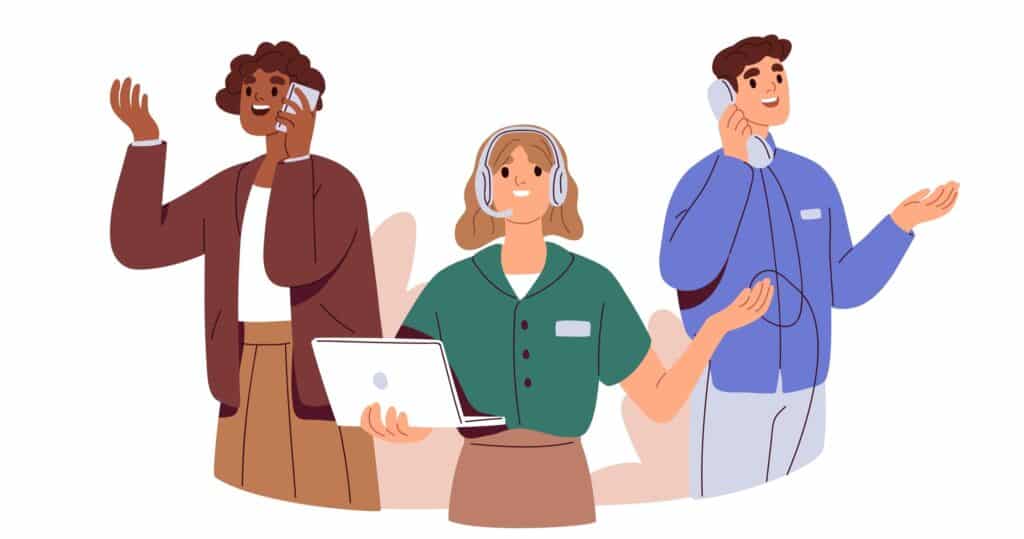
I was delivering social selling training to a company recently when one of the sales reps said the one thing ALL sales managers hate to hear.
As a former sales leader myself, it sent shivers up my spine.
The worst part is that it represents a HUGE problem in sales right now.
What is this problem you ask?
The Power of the Phone for Sales Teams
It might seem a little ironic—I am a LinkedIn & Social Selling trainer—but I’ve worked in sales all my life. I’m someone who has made tens of thousands of cold calls, and someone who has led cold calling teams of 300+ sales reps. I fully understand the power of the phone for sales teams.
Which is why I have, and always will, encourage salespeople and sales teams to use the phone and LinkedIn TOGETHER.
During this training session, I mentioned seeing someone in my network post on LinkedIn just one week prior that they were actually in the market for the product that this particular company actually sold!
It was one of those “Can anyone in my network recommend a provider of X or Y, please” posts that you see.
I tagged one of the directors from this company and suggested they reach out, as I knew they were great at what they did. Unfortunately, the director wasn’t active on LinkedIn, so they didn’t take action on this genuinely hot lead.
Luckily, one member of the sales team was way ahead and saw that the director was tagged. They acted on this amazing opportunity!
They wrote a comment, sent a connection request, and after the connection was accepted, sent a nice little message saying that they would love to discuss the prospect’s requirement in more detail.
Now, in the world of social selling, this is an amazing start! There are loads of sales reps who wouldn’t have seen this post in the first place or thought to proactively act on it.
It had been just over 7 days from that salesperson seeing, connecting, and messaging this prospect, so I asked the rep—the whole team was listening at this point—”What happened next?” I expected to hear they had booked or even sat a meeting with them.
This rep turned to me and very proudly said: “I’m just waiting for them to reply.”
What Happens When You Leave a Prospect Hanging
Cue my genuine reaction:
I’m sorry, what?

You are waiting for them to reply? It’s been over a week, and you’re still waiting for them to reply?
I went on to explain that the person who wrote on LinkedIn that they needed something probably had 100+ salespeople comment on the post, 100+ new connections, 100+ messages in their inbox, etc. It is hugely overwhelming and very difficult to reply to every single person.
The reality, unfortunately, is that most of those sales reps who comment, connect, and message also will be sitting there waiting for a reply.
A reply that for most of them (if not all of them) will never come.
My advice to this particular sales rep: JUST PICK UP THE PHONE AND CALL THEM!
I guarantee you that very few salespeople who jump onto these LinkedIn posts will pick up the phone and give the prospect a call.
There are too many salespeople, both old and young, who are scared to pick up the phone.

Look, you know it must be bad if a social selling trainer is complaining about people not using the phone, right?
Forget debates about cold calling versus social selling.
Forget accusations of millennials being scared of the phone.
Here is the simple truth:
As long as people use the phone, it will remain a powerful sales tool.
Why are salespeople scared of the phone, though?
The Fear of Rejection
This fear comes from a few areas.
The first is fear of rejection. When you send an email, you’re hidden behind your computer. When you comment on a LinkedIn post, if you don’t get a reply, then that rejection isn’t as personal. However, when you’re on the phone with someone, that rejection can be harsh and uncomfortable.

Often a lot of what we want in life is on the other side of uncomfortable.
If you let fear of the phone control you, chances are you’ll miss that sale. If you keep looking to send an email, text, or LinkedIn message as a way of avoiding the phone, you’ll miss opportunities.
That’s not to say that email, text, social, etc., aren’t good methods; they 100% are.
It’s when you use them to cover up your fear of picking up the phone, or you wait too long for replies that will never come, that it becomes a problem.
The Fear of the Unknown
Sales reps also fear what they don’t know.
Many salespeople don’t know how to use the phone successfully, and it’s scary having to learn something new.
Trust me, there are just as many salespeople who are scared to use social media. They’ll hide behind making constant calls to people who will never answer or return them to avoid learning how to use LinkedIn.
Fear is crippling salespeople and sales teams, but it can be overcome. This problem can be CURED! But you do need to understand one thing first:
Working in sales ISN’T easy.
The whole reason that salespeople get paid a commission for what they do is because they have to work hard and overcome challenges to win each sale. You don’t get paid for making calls. You don’t get paid for commenting on someone’s LinkedIn post. You get paid for WINNING and closing sales. Everything else is part of the sales process.
So, How Bad Do You Want the Sale?
The salespeople out there who want the sale MORE are the ones who don’t let fear hold them back. They will pick up the phone if they need to, they’ll jump on LinkedIn, or they’ll get in their car and drive there!
Remember:
- The phone is not dead.
- Social selling is not dead.
- Email is not dead.
- Sending letters is not dead.
- Networking is not dead.
If you’re working in sales right now, you have the single BEST opportunity that any salesperson has ever had. There have never been more ways to reach prospects and customers than there are right now.
Salespeople have the opportunity to leverage so many tools that allow them to reach more people.
Don’t let fear of rejection hold you back.
Don’t let fear of what you don’t know hold you back.
If you REALLY want the sale, you’ll let nothing stand in your way!
The Bottom Line
Go out there today, look at your opportunities, and look at all the amazing tools at your disposal. Be creative, be persistent, be passionate, and try harder than you’ve ever tried to go out there and help people solve more problems with your product.
The best in sales use all tools and if you’re keen to learn how to master LinkedIn, Sales Navigator & Social Selling, head to Sales Gravy University to learn more from Daniel Disney.

![6 High-Probability Moments to Send LinkedIn Connection Requests Prior to an Event Events create natural relevance. Conferences, trade shows, user groups, and local meetups give you a reason to connect that does not feel forced. The mistake sellers make is waiting until the event starts or turning the request into a pitch. A better move is connecting days or weeks ahead with a simple acknowledgment of the shared event. Example: Hi Sarah, saw you’re attending the Midwest Manufacturing Summit next month. I’ll also be there and am super excited! I’d love to catch up in person at the event. In the meantime, let’s connect here on LinkedIn. You are aligning with something already on their calendar. When you see them at the event or reach out afterward, your name is no longer unfamiliar. Following an Event After an event, connection requests work best when they reference a real interaction, even a small one. A short conversation, a question during a session, or a brief introduction creates enough context. The request should reflect that moment, not attempt to convert it into a follow-up. Example: Tim, I enjoyed meeting you at the conference last week. Your take on [subject/trend/idea] was intriguing. I look forward to staying connected and to our next conversation. This reinforces continuity and professionalism without pushing the relationship forward prematurely. After a Sales Call Sending a connection request after a sales call is one of the most underused opportunities in prospecting. If the call was answered and productive, the request reinforces credibility and continuity. Example: Thanks again for the conversation today. I appreciated your perspective on how your team is thinking about next quarter. I look forward to our next meeting and sharing some ideas I have with you and your team. If the prospect did not answer, a connection request can still make sense as a light reinforcement, especially early in the relationship. It keeps your name present without escalating pressure. Either way, the request works because the call establishes legitimacy first. After a Meaningful Interaction Not all interactions happen in formal selling environments. Thoughtful exchanges in comment threads, group discussions, or brief conversations in passing all create natural moments to connect. That might mean running into each other at a non-work event, crossing paths at an airport, or chatting briefly in a line somewhere unexpected. Example: Haley, it was a pleasure meeting you on our flight to Atlanta. Thank you for your restaurant recommendations! I look forward to staying connected, What makes this work is that the interaction was real. The request simply continues it. Mutual Connections Shared connections reduce perceived risk when handled with restraint. They signal that you operate in similar professional circles, not that you have permission to pitch. The mistake is overexplaining or implying endorsement. Example: Hi Mark, I noticed that you are connected to my good friend, James, and since you are also [interested in, working in, located in] I thought it might make sense for us to be connected also. A simple acknowledgment is enough. Familiarity does the work. Profile Views Profile views signal awareness, not intent. When someone views your profile after a call, email, or content interaction, a connection request can make sense as a low-pressure acknowledgment. Example: Wendy, thank you for visiting my profile. I had a chance to look at yours, and based on your interests, I thought it might make sense for us to connect. The discipline is resisting the urge to read more into it than is there. Want the exact framework for integrating LinkedIn into a disciplined outreach sequence without pitching, spamming, or wasting time? Buy The LinkedIn Edge by Jeb Blount and Brynne Tillman today. Sales Gravy is the number one sales training organization](https://salesgravy.com/wp-content/uploads/2025/12/6-Moments-LinkedIn-Connection-Requests-Actually-Work-in-Prospecting-Sales-Gravy-Blog-Featured-Image-768x401.jpg)
