
Summary at a Glance:
- Training vs. Coaching: Training provides the raw material (knowledge and skills), while coaching provides the refinement and application needed for mastery.
- The Execution Gap: The difference in performance after training is rarely about the curriculum; it is about the lack of guided, real-world practice.
- The Starting Line Mentality: Effective leaders treat the end of a training session as the beginning of the development process, not the finish line.
- Bridging the Gap: Coaching bridges the “knowing-doing” gap by using observation (field rides, call listening) to address individual execution hurdles.
- Continuous Improvement: Performance is a cycle, not a one-time event. Sustained behavior change requires a repeating loop of training, observation, and coaching.
When people leave training, why don’t they all perform at the same level?
Training and coaching occupy different positions in the development process. One without the other leaves the job half done.
Every leader has sent people through the same training program and watched wildly different levels of execution come out the other side. Some people applied what they learned immediately. Others forgot it within a week.
Training provides the raw material. Something else is needed to turn that material into consistent, applied behavior. That something else is coaching.
Training is Knowledge Acquisition. Coaching is Knowledge Application
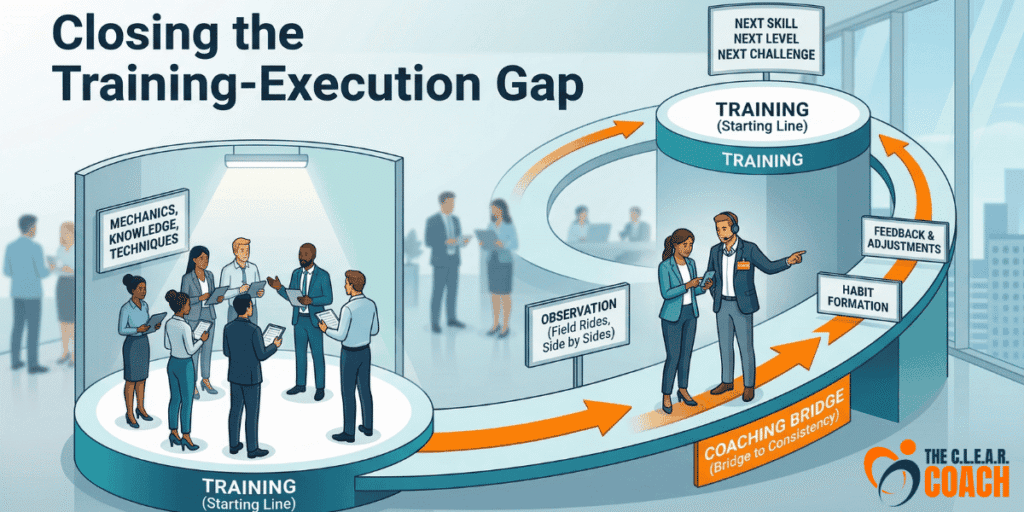
Training helps seller acquire knowledge and sales skills. Observation (through field rides, side by sides, and listening to calls) reveals how the individual is applying what was taught.
Coaching addresses the gaps between what was taught and what is being executed. Follow-up ensures that coaching adjustments are being implemented and sustained.
Then the cycle repeats, because there is always a next skill to develop, a next level of performance to reach, a next challenge to overcome.
Training and coaching are not competing activities. They are two stages in a single, continuous development process.
Training Should Not Be a Check-The-Box Activity
Leaders who don’t get this send people to training, check the development box, and wonder why nothing changes.
Leaders who understand the distinction treat the training event as the starting line, not the finish line. They plan the coaching follow-through before the training even begins and understand that through coaching, training sticks, and behavior transforms.
Training transfers knowledge and teaches skills. People leave training with new information. They have practiced techniques in a controlled environment.
Coaching takes what was acquired in training and helps the individual apply it in the real world, under real pressure.
Coaching Closes the Gap Between Knowing and Doing
The gap between knowing a technique and doing it consistently is enormous. Coaching bridges that gap by building competence and habit through repeated, guided practice in the field.
Think about it in terms of athletics. A coach can teach a basketball player the mechanics of a free throw in a training session. But the player becomes reliable through repetitions where the coach observes, provides feedback, makes adjustments, and builds the muscle memory.
Sales is no different. Knowing how to handle an objection is not the same as handling an objection effectively under pressure. That transformation from knowledge to execution requires coaching.
People Also Ask
Most teams fail to apply training because there is a gap between classroom knowledge and real-world execution. Without post-training coaching to build muscle memory and habit, information is quickly forgotten. This is exactly the problem Sales Gravy’s CLEAR Coaching™ leadership development program solves.
Neither is “better”; they are interdependent. Training introduces the skill, while coaching ensures that skill is sustained and applied under pressure.
The “Finish Line” approach treats training as a one-time event that ends when the session is over. The “Starting Line” approach treats training as the beginning of the development process, where the real work of behavioral change begins through post-training coaching and field application.
The most effective reinforcement is a continuous cycle of observation and feedback. Leaders should use field rides, side-by-side sessions, and call listening to identify execution gaps and provide immediate, actionable coaching adjustments. It is also advisable to include e-learning reinforcement, like what you’ll find on Sales Gravy University combined with coaching.
Stop Wondering Why Training Isn’t Sticking.
Most sales training fails because the follow-through is missing. The CLEAR Coach™ Leadership Training Program gives your managers the specific framework they need to bridge the gap between “knowing” and “doing.” Learn How to transform your leaders into elite coaches who drive consistent, repeatable execution.