
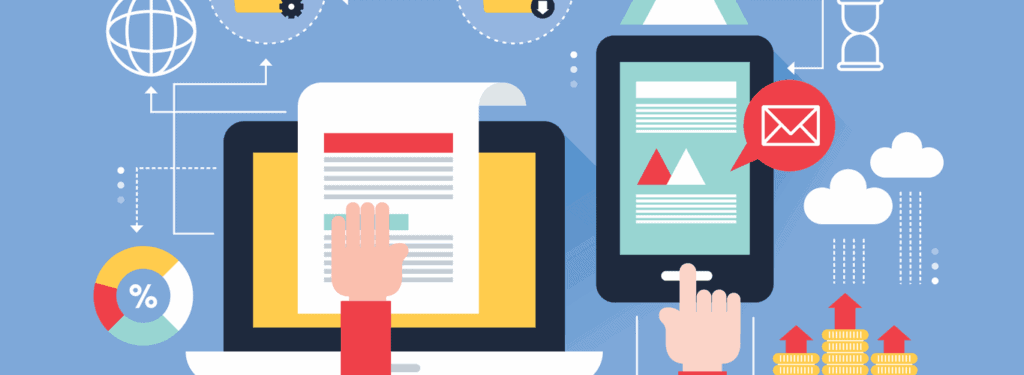
If your cyberspace storefront is not keyword-rich, easy to navigate, and ladled with fresh content, you will have visitors who stay less than 10 seconds. How exactly does that increase sales?
Each day I receive notice for another social media training workshop – be it for LinkedIn, Facebook or Twitter.
Recently, a potential customer (a.k.a. prospect) contacted me about whether or not he should attend one being offered by a local social media expert and business coach.
Believing in never knocking the competition, I suggested that many of these learning or training engagements presume that you have an effective website.
Further conversation with this potential customer revealed he was not happy with the lack of traffic to his website. And this, my friends, is the fatal marketing presumption.
Until this obstacle (an unfriendly website) is removed, then learning more about social media will probably not secure the results you want.
Within this marketing strategy, the ultimate goal is to drive traffic to your website.
If your cyberspace storefront is not keyword-rich, easy to navigate, and ladled with fresh content, you will have visitors who stay less than 10 seconds.
How exactly does that increase sales?
Now, efficient and effective for me is defined as doing things right and doing the right thing. With respect to a website, this translates into quality and keyword-rich content that delivers high traffic and eventually more profit, regardless of whether the business is engaged in selling services, products or a combination of both.
The majority (at least 50%) of small business owners, including single office/home office entrepreneurs who have websites, have invested hundreds (if not thousands of dollars) to create and maintain them.
Yet, these hardworking entrepreneurs are receiving little to no traffic and the situation is not improving.
Now, I am not a “tekkie” person. In fact, I am technology challenged. However, during the last 5 years, I have invested thousands of hours to improve my website on my own time.
I can trace this improvement directly back to my business action plan and how I dramatically revised both my marketing action plan and sales action plan over 5 years ago.
In other words, I do not spray and pray my activities with the hope that something will stick.
Five years ago, I had one of those “I could have had a V8” moments, or what I call a Swedish FHEM (flat head experience moment).
Being a single office/home office entrepreneur, I had neither the resources nor expertise in marketing.
Sure, I attended local business networking events, chamber luncheons, and other opportunities to meet and greet. However, the results were not in proportion to the efforts I demonstrated. I realized there had to be a better way.
One of my mentors, Ray Overdorff, suggested that I invest one hour per day in expanding my knowledge of marketing and, in one year, I would become an expert, or at least far more knowledgeable.
He was on target.
In the book, “Outliers,” the author Malcolm Gladwell suggests it takes 10,000 hours to be truly successful.
For the last 5 years, I have planned my marketing and worked my education-based marketing plan by contributing to such sites as:
- EvanCarmichael
- EzineArticles
- NBiz Magazine
- Post Tribune of Northwest Indiana
- Sales Bloggers
- Sales Gravy
- Top Sales Experts
I am reaping the rewards of my education-based marketing efforts because my site continues to attract new visitors each day.
So, if you are considering taking any social media training, make sure your website is operating as close as possible to full warp power.
Then, take that social media training to supercharge your marketing warp engines. You will find all of your efforts truly helping you increase sales.
![6 High-Probability Moments to Send LinkedIn Connection Requests Prior to an Event Events create natural relevance. Conferences, trade shows, user groups, and local meetups give you a reason to connect that does not feel forced. The mistake sellers make is waiting until the event starts or turning the request into a pitch. A better move is connecting days or weeks ahead with a simple acknowledgment of the shared event. Example: Hi Sarah, saw you’re attending the Midwest Manufacturing Summit next month. I’ll also be there and am super excited! I’d love to catch up in person at the event. In the meantime, let’s connect here on LinkedIn. You are aligning with something already on their calendar. When you see them at the event or reach out afterward, your name is no longer unfamiliar. Following an Event After an event, connection requests work best when they reference a real interaction, even a small one. A short conversation, a question during a session, or a brief introduction creates enough context. The request should reflect that moment, not attempt to convert it into a follow-up. Example: Tim, I enjoyed meeting you at the conference last week. Your take on [subject/trend/idea] was intriguing. I look forward to staying connected and to our next conversation. This reinforces continuity and professionalism without pushing the relationship forward prematurely. After a Sales Call Sending a connection request after a sales call is one of the most underused opportunities in prospecting. If the call was answered and productive, the request reinforces credibility and continuity. Example: Thanks again for the conversation today. I appreciated your perspective on how your team is thinking about next quarter. I look forward to our next meeting and sharing some ideas I have with you and your team. If the prospect did not answer, a connection request can still make sense as a light reinforcement, especially early in the relationship. It keeps your name present without escalating pressure. Either way, the request works because the call establishes legitimacy first. After a Meaningful Interaction Not all interactions happen in formal selling environments. Thoughtful exchanges in comment threads, group discussions, or brief conversations in passing all create natural moments to connect. That might mean running into each other at a non-work event, crossing paths at an airport, or chatting briefly in a line somewhere unexpected. Example: Haley, it was a pleasure meeting you on our flight to Atlanta. Thank you for your restaurant recommendations! I look forward to staying connected, What makes this work is that the interaction was real. The request simply continues it. Mutual Connections Shared connections reduce perceived risk when handled with restraint. They signal that you operate in similar professional circles, not that you have permission to pitch. The mistake is overexplaining or implying endorsement. Example: Hi Mark, I noticed that you are connected to my good friend, James, and since you are also [interested in, working in, located in] I thought it might make sense for us to be connected also. A simple acknowledgment is enough. Familiarity does the work. Profile Views Profile views signal awareness, not intent. When someone views your profile after a call, email, or content interaction, a connection request can make sense as a low-pressure acknowledgment. Example: Wendy, thank you for visiting my profile. I had a chance to look at yours, and based on your interests, I thought it might make sense for us to connect. The discipline is resisting the urge to read more into it than is there. Want the exact framework for integrating LinkedIn into a disciplined outreach sequence without pitching, spamming, or wasting time? Buy The LinkedIn Edge by Jeb Blount and Brynne Tillman today. Sales Gravy is the number one sales training organization](https://salesgravy.com/wp-content/uploads/2025/12/6-Moments-LinkedIn-Connection-Requests-Actually-Work-in-Prospecting-Sales-Gravy-Blog-Featured-Image-768x401.jpg)
