

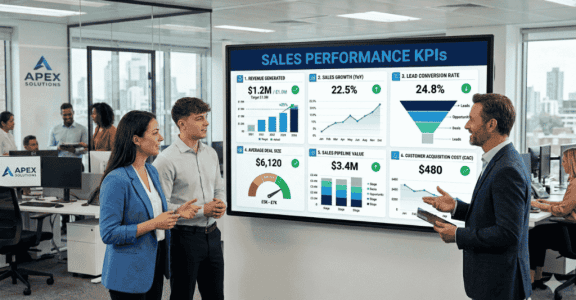
Quick Summary
The best way to measure sales success is with leading indicators: the KPIs and metrics that predict future revenue instead of just reporting it. Closed deals are a lagging indicator. They tell you about the past, and by the time revenue dries up you are already months behind. Track metrics across three areas, your funnel, your revenue, and client retention, and review them weekly so you can spot problems and fix them while there is still time to change the outcome.
Key Takeaways: How to Measure Sales Success with KPIs and Metrics
- Closed deals are a lagging indicator. Measuring only revenue tells you about the past—by the time sales dry up, you’re already months behind and past the point of easy recovery.
- KPIs are leading indicators. They give you an early, objective view of pipeline health, so you can spot trouble and fix it before it costs you revenue.
- Know the difference between pipeline and forecast. Your pipeline is every opportunity regardless of close probability; your forecast is the qualified subset expected to close in a set period. Tracking both can get you within about 5% forecast accuracy.
- Track KPIs across three areas. Funnel metrics (qualified leads, sales cycle length, stage-to-stage conversion), revenue metrics (average deal size, proposal-to-close ratio, quota), and retention metrics (client growth and retention rates) together give the full picture.
- Set benchmarks from real data. Use your own sales history—or industry benchmarks if you’re new—and combine your average deal size with your conversion rate to know exactly how full the pipeline must be to hit quota.
- Review weekly and coach to the numbers. KPIs only help if you act on them. Review trends every week, ideally in a coaching session with each rep, to catch lags early and course-correct fast.
Why You Need to Start Looking Beyond Closed Deals to Measure Sales Performance
Too often when looking at a sales team’s success, sales managers only look at the actual sales (the closing of the business). Of course, this is important—but the sale is a lagging indicator.
If you have no sales closing today, it indicates that your team has not been performing well for months.
By the time you’re at the point of no business, you’re already well into trouble. In fact, you are at the point of no return.
So how, as sales leaders, do you create leading indicators, tracking the behaviors required today for sales tomorrow?
Focus on Leading Indicators and the Metrics That Matter
The answer is Key Performance Indicators (KPIs). KPIs are important leading indicators that ensure you have a healthy pipeline and future business.
They provide an objective form of measurement that allows you a glimpse into your future—before it’s too late to change the direction or solve any issues with your team.
The first step in determining which KPIs to measure and how to measure them correctly is to differentiate between a sales pipeline and a sales forecast--two terms that many sales professionals mix up or don’t differentiate.
Sales Pipeline vs Sales Forecast KPIs
A sales pipeline provides clear visibility into all of your opportunities, regardless of their probability of closing, whereas a forecast is a subset of the pipeline that only includes those qualified opportunities that are expected to close in a defined reporting period.
A properly defined pipeline and its stages help you organize your sales process and create effective tools and benchmarks for your sales team, making it much easier to predict the future success of your sales force.
In fact, using KPIs, it’s possible to get within 5 percent forecast accuracy, meaning that you’ll always know not only how your team is currently performing, but also what roadblocks might lie ahead.
A sales forecast is a forward planning tool for budgets and spending, and measuring KPIs around lead conversion success, such as the cost per lead, can help you budget appropriately and accurately predict your revenues.
The KPIs Every Sales Manager Should Measure
KPI’s for funnel development:
The prospecting side of your funnel deserves its own numbers. Here’s how to approach setting key performance indicators for prospecting so you’re measuring every touch it takes to reach a decision maker, not just the first dial.”
- Number of qualified leads in the pipeline
- Sales cycle length
- Total length of time to qualify a new prospect
- Qualified to proposal ratios
- Number of evaluations / short lists per year
- Number of new (first) client meetings per month
- Cold lead to qualified ratios with conversion rates
It’s important to not only measure your opportunity-to-close ratio but to measure conversion from stage to stage.
Keeping an eye the length of your sales cycle, the number of new client meetings you have each month, and the conversion ratio of new leads to qualified leads will provide insights on whether you will be ahead or behind on future revenue and how you can best adjust now to ensure you will hit your future revenue goals.
Deals stall between stages when reps don’t follow up. These eight tips for making the perfect follow-up call keep opportunities moving and your sales cycle honest.
Revenue and quota focused KPI:
- Proposal to closed ratio
- Average deal size
- Number of sales per year
- Annual quota
- New vs. existing client sales
KPI’s for Account Management and client retention/growth:
• Average client growth year over year
• Client retention rates
Retention numbers improve when your team works existing accounts deliberately. Start with these account expansion habits of top-performing account managers.
Depending on your business, you may have additional KPIs to take into account.
- A staffing company, for example, would measure positions filled.
- A company with multi-year contracts and varying usage would measure contract value versus actual contract spend, for example.
- Software as a Service companies would measure average contract value and average length the client stays in the program.
Smart Leaders Use Data and Objectivity When Establishing KPIs
Each should have an appropriate benchmark based on actual data and information from your sales history or benchmarks from the industry if you are a new startup.
Review your sales from prior years or quarters to help you calculate averages and quotas.
Understanding your average deal size and combining that with your lead conversion rate will give you an idea of how many opportunities need to be in the pipeline in order to hit your quotas in a very objective and scientific way.
Of course, measurements are only helpful if they’re paid attention to. Get to know your KPIs, and review your data weekly. Pay close attention to any trends—both worsening and improving—so you can react appropriately. And if there’s no one in your organization with the time or experience to own this weekly rhythm, that’s exactly the gap a fractional sales leader fills.
Why You Should Include Your Sales Team in the Process
It’s helpful to include your sales team in this process; review each person’s KPIs once a week in a coaching session.
This will help them to understand the types of behaviors that are important and will ensure that you spot any lags in performance early and can course correct quickly.
With a Clear Set of KPIs You Will Avoid Being Blindsided by Missed Forecasts
No one likes to be blindsided by poor sales, and there is no reason to not see what is coming!
There are few opportunities in life to accurately predict the future. But paying attention to leading indicators now is an opportunity not only to predict, but to change the future course of your sales.

Want to turn these KPIs into a weekly coaching and performance management rhythm? See how CLEAR Coach trains sales leaders to do exactly that.
FAQs Leaders Ask About Sales KPIs
Measure sales success with leading indicators—the KPIs and metrics that predict future revenue—rather than relying only on closed deals, which are a lagging indicator of past performance. Track metrics across your funnel (qualified leads, sales cycle length, conversion rates), your revenue (average deal size, proposal-to-close ratio, quota), and client retention. Reviewing these regularly lets you spot problems early and course-correct before sales decline.
A lagging indicator, like closed sales, only tells you what already happened—by the time it drops, you’re already months into trouble. A leading indicator, like the number of qualified leads or new client meetings, predicts future results and gives you time to change course. KPIs are leading indicators, which is what makes them so valuable for steering a sales team.
The core KPIs fall into three groups. Funnel development: qualified leads in the pipeline, sales cycle length, and stage-to-stage conversion rates. Revenue and quota: proposal-to-close ratio, average deal size, and new versus existing client sales. Account management: client retention rates and year-over-year account growth. Some businesses add industry-specific metrics—positions filled for a staffing firm, or average contract value for a SaaS company.
A sales pipeline includes all of your opportunities, regardless of how likely they are to close. A sales forecast is a narrower subset—only the qualified opportunities expected to close within a defined reporting period. Defining both clearly helps organize your sales process and can push forecast accuracy to within about 5%.
Review your KPIs weekly so you can react to trends—both improving and worsening—before they affect results. It helps to review each rep’s numbers in a weekly coaching session, which reinforces the right behaviors and lets you catch performance lags early enough to fix them.


