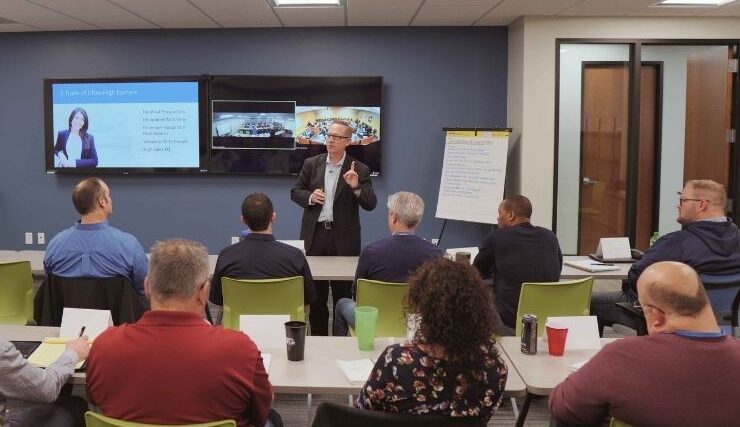
This time of year is critical. As sales leaders map out their budgets for the new year, the conversation always centers on a core conflict: How to cut expenses and, simultaneously, motivate teams to hit larger quotas.
What’s the first line item to feel the squeeze? Training and development.
It is often incorrectly labeled as a ‘want’ and not a ‘need.’ We hear leaders say, “It can wait until next quarter,” or, “Once we stabilize revenue, we’ll invest in the team.”
This short-sighted thinking doesn’t save money. Instead, it’s costing organizations a significant, quantifiable amount of revenue and talent. When professional development is treated like a luxury, we undermine the foundational ability of our teams to perform consistently at a high level.
Training is the Foundational Requirement for Peak Performance
Sales leaders should consider peak performance in any high-stakes environment. In the military, or in elite professional sports, ongoing training is not a choice—it is a non-negotiable, daily priority.
So why is it that, in Sales, we view continuous development as optional or too expensive? The simple truth is that lack of training is the most expensive mistake you can make.
Think about the rate of technological change. Most of us have upgraded our cell phones in the last three to five years because the old ones simply couldn’t keep up.
The same principle applies to your sales team’s skill set. If your representatives are still relying on techniques learned 5, 10, or 15 years ago, then they are operating at a competitive disadvantage. They will be outmaneuvered and outperformed by competitors who are strategically investing in modern sales frameworks every time.
Henry Ford’s famous quote still holds true: “The only thing worse than training employees and losing them is to not train them and keep them.” If you believe training is expensive, you must take a moment to calculate the monumental loss of reps consistently missing their quotas.
The True Cost of Inconsistency and Turnover
Look at the numbers. Assume three of your representatives are consistently missing quota by just 20%. That deficit is lost revenue—but it also represents wasted leads, missed opportunities, and the corrosive ripple effect of deals that never even make it into your pipeline. The amount of potential revenue lost due to underperformance is often far greater than the entire annual budget you would allocate to comprehensive sales training.
Action Plan for Sales Leaders & Managers
To reverse this loss, you must treat coaching as a continuous operational requirement, not a perk.
- Calculate the ‘Cost of Inaction’ to Justify Budget: Reframe thinking of training as an expense and start focusing on the cost of the status quo. Calculate the annualized revenue loss from your bottom 20% of underperforming reps (e.g., missed quota * average deal size). Use that concrete number to justify and secure a budget for development, proving that not training is your biggest liability.
- Implement a Continuous Coaching Framework: Don’t rely on annual training events. Transform your managers into daily coaches by mandating 30 minutes of structured, one-on-one coaching per week focused on skill development. This reinforcement is what locks in new behaviors and prevents the initial energy gained in training from fading.
The Hidden Expense of Disengagement
Talent turnover is another critical cost of lack of training that is often overlooked. A representative who feels unsupported, or who consistently misses quota because they don’t have the necessary tools and coaching, is highly likely to seek opportunities elsewhere.
The cost of recruiting, onboarding, and ramping a replacement—which includes the loss of established customer relationships and the disruption to team morale—significantly outweighs the expense of proactive investment.
How to Take a Struggling Rep From Liability to Asset
A struggling representative is not necessarily a failure. More often than not, they are simply a motivated individual who has not been properly coached, developed, or given a clear framework for success. They begin their job eager to prove themselves, but without guidance, that initial energy quickly dissipates.
Investing in development can be the deciding factor that transforms a dedicated, yet struggling, team member into a consistent top performer. When you strategically invest, you convert what could have been a liability into a high-value asset for your organization. You also ensure that the talent seeking growth and success will find it with you, not with your competition.
Action Plan for Sales Leaders & Managers
- Implement a Mandatory Tiered Coaching Cadence. Shift from generic pipeline reviews to mandating a structured, tiered coaching system: Tier 1 (The Weekly Huddle) for metric accountability; Tier 2 (The 1-on-1 Call) for strategic deal review; and Tier 3 (The Dedicated Call Critique Session) where the rep listens to and dissects a recent call recording (a win or a loss).
- Run a Quarterly ‘Skill Obsolescence’ Audit. Your team’s skills are your greatest asset, but they have a shelf life. Conduct a quarterly audit to identify the top three techniques that are obsolete but still being used by your underperformers (e.g., leaving long, rambling voicemails or sending generic proposals). Then, mandate a one-week “kill period” where your entire team replaces that obsolete technique with a modern, proven one.
The Strategic Advantage of a Cohesive Culture
When you commit to consistent training, you don’t just sharpen skills—you create alignment, clarity, and confidence across your organization. Every team member speaks the same sales language, follows a unified playbook, and builds the same winning habits.
Training sharpens individual skills, but it also creates a culture where representatives feel supported, valued, and fundamentally equipped to win. The world’s best-performing organizations, from elite sports teams to world-class businesses, all share one critical characteristic: They never stop training.
As you plan for the year ahead, move past the outdated notion that development is an optional line item. See it as the essential fuel for your sales engine.
If you are serious about hitting bigger quotas, accelerating deal velocity, and retaining your high performers, sales training has to be a strategic priority. The organizations that win are not the ones that cut corners on development; they are the ones that double down on it.
Don’t budget for failure. Invest in the skill set that guarantees your next quarter’s revenue.
Don’t let your pipeline run on empty. Take control of your team’s performance today. Enroll your team in the next Fanatical Prospecting Bootcamp Live or visit Sales Gravy University to find more high-impact training options and learn more from Master Trainer Jessica Stokes.