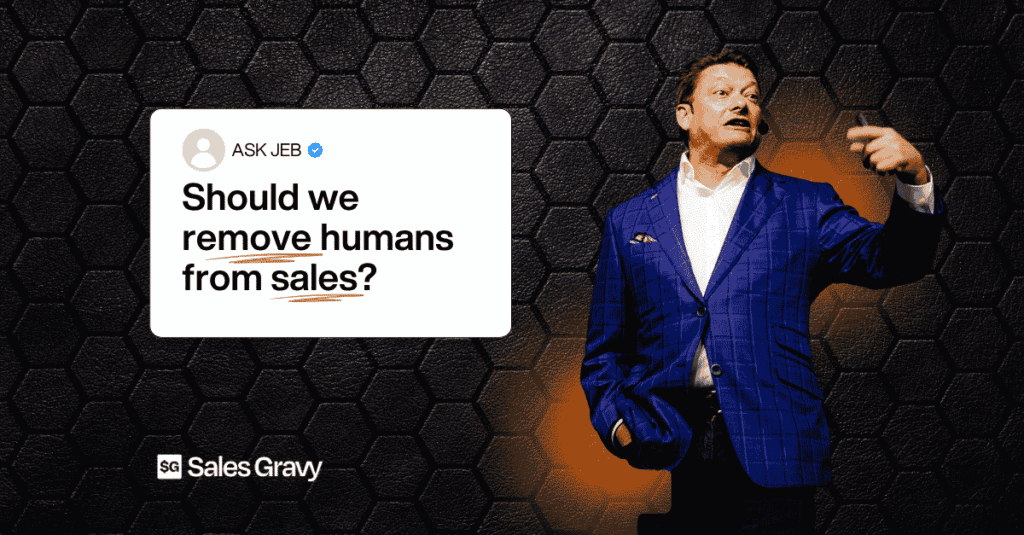
AI works for sales when the purchase is simple and low risk enough that a buyer feels comfortable clicking a button without talking to anyone. The moment a deal gets complex, expensive, or risky, the buyer needs a human in the loop to build trust and close the gap.
Key Takeaways
- AI sales agents work best for low-cost, low-risk purchases that buyers are comfortable making without talking to a person.
- Complex sales involving custom work, high dollar amounts, or real business risk almost always require a human to build trust and answer objections.
- Pure AI-driven outbound, whether voice or email, breaks down the moment a prospect pushes back with a real objection or figures out they are talking to a bot.
- Running your full prospect list through an AI engine without human oversight can burn through that list and your reputation in under 30 days.
- The smarter move is not going human-less. It is using AI to make your current sales team faster, better informed, and focused on the buyers who are ready to buy.
I had Shakaib Arsalan on the show from Pakistan, a CTO running a 120-person company called Ultra Codes that sells technical and software resources to US companies. His CEO had seen another company’s AI prototype and wanted to go human-less in sales. Shakaib’s gut told him to keep people in the loop, but he wanted to know if he was wrong.
What You’re Selling Determines Whether You Need a Human
It all comes down to three questions.
- What are you selling?
- What’s the risk?
- What’s the complexity?
If people can buy what you sell without needing to talk to someone to trust it, and they feel comfortable making that decision on their own, you can absolutely go human-less.
That’s been true since the early 1900s, when people ordered straight out of a catalog. It’s true today when you buy something off Amazon. I bought a $12 a month voice activated AI software tool and never talked to a human to do it. But if I were rolling that same tool out across my entire enterprise at a $100,000 price tag, I’m talking to somebody first. The bigger and more complex the decision, the more a human matters.
For Shakaib’s business, that’s the real test. He’s selling technical resources and developers who are going to work inside a client’s systems and solve real IT problems. If I’m the CEO bringing in overseas talent to touch my systems, I am going to want to talk to a person. There’s no version of that deal where I hand over access without a conversation first.
The Easiest Path to Human-less Sales Is Marketing, Not Sales
If you want to go human-less, the easiest way to do it is on the marketing side, not the sales side. Buy enough pay-per-click traffic, build a compelling enough offer on your website, and people will buy without you lifting a finger. Add an AI chatbot to answer basic questions, and you’ve got a real human-less motion. You don’t need a sales team for that. You need a strong offer and the budget to drive traffic to it.
Why Pure AI Outbound Burns Your List
Where this falls apart is when companies try to replace outbound selling with AI instead of marketing. The technology is not there yet. An AI voice can’t hold a real conversation once a prospect throws a complex objection at it, and it breaks down fast. The second someone realizes they’ve been talking to a bot instead of a person, they hang up, because nobody wants to talk to an AI that pretended to be human.
Email is no different. There are AI tools that let you blast everybody on a list, and that’s a big reason email has lost so much of its punch as a sales channel over the last two to three years. People are buried in AI-generated noise, and they’re deleting it without a second look.
What makes this worse is that the people you’re marketing to are real decision makers with budget authority. The moment they sniff out that they’re being spammed by an AI, they block your domain entirely, because they know an AI won’t quit. A real person eventually gives up after a few tries. An AI keeps coming back day after day after day. Run your whole list through an AI outbound engine, and you’ll get a short burst of results before that list is burned and your name is blocked across the board. If you try to go fully human-less in outbound sales, you’re going to tank your pipeline fast, and getting your sales team back once you’ve gutted it is a long, hard climb.
AI Enhanced Sales Reps, Not AI Replaced Sales Reps
None of this means AI has no place in your sales process. It means the win isn’t replacing your people, it’s enhancing them. If you’ve got reps selling for you right now, the real question is how you speed them up. How do you get better information in front of them faster? How do you feed them signals on which buyers are actually ready to move? How do you combine that intelligence with what your marketing team is already doing?
Do that well, and you may shrink the size of your sales force while growing your output, because your people are spending their time in front of the right buyers at the right moment instead of guessing. That’s a very different outcome than going human-less. You keep the humans. You just make them sharper.
There may come a point where certain transaction sizes make economic sense to hand fully to AI. But for big projects and bigger customers, you need people on the phone. That’s not going to change anytime soon.
The more complex a decision, the more a buyer needs a human in the loop who can cut through the noise, build trust, and make it easy to say yes. Buyers want confidence in their decisions, and complex decisions will always demand a human being to deliver that confidence. The less complex the decision, the more exposed that sale is to automation. Know which one you’re running, and build your sales process around the truth of it instead of the hype.
If you’re trying to figure out exactly where AI fits in your sales process without losing the human edge that actually closes deals, grab the free Book Club Guide for The AI Edge. It’s built to help you work through the book together and turn it into a real plan, so AI becomes a weapon for you instead of a replacement for it.

Common Questions About When to Use AI in Sales
No. AI works well for low-risk, low-complexity purchases that buyers are comfortable making on their own, but complex or high-dollar sales still require a human to build trust and handle objections.
AI struggles the moment a prospect raises a real objection or asks a complex question, and once someone realizes they’re talking to a bot, they disengage. Pure AI outbound also risks getting your domain blocked and your list burned through quickly.
The best use of AI in sales is enhancing your existing reps with better data and stronger buyer signals, not replacing them, so they spend their time in front of the right buyers at the right time.
Ask whether your buyer needs to trust you to say yes. The more cost, custom work, or business risk involved, the more your buyer needs a real conversation with a human before they’ll commit.